
INTRODUCTION
© Penelope Cowley
Nonlinear phenomena lie at the heart of every theory of gravity consistent with experiment and observation. Yet our understanding of strong gravity—the highly nonlinear, dynamical regime near black holes and other compact objects—is still in its early stages. Today, this field is poised for a revolution, driven by simultaneous advances in theory, computation, and observation.
On the theoretical side, breakthroughs in mathematics and gravitational physics are revealing new insights into black holes and their dynamics, especially during violent collisions. Computational progress is enabling high-precision simulations of these events, while a new generation of gravitational-wave detectors is opening unprecedented observational windows into the strong-gravity universe.
The Simons Collaboration on Black Holes and Strong Gravity (SimonsC-BHSG) unites leading researchers across three interconnected domains: theory (gravitation, mathematical relativity, high-energy physics), computation (numerical simulations of relativistic mergers, high-performance computing), and observation (gravitational-wave astrophysics, data analysis, machine learning). By combining these perspectives, we are developing novel models of strong-gravity phenomena and pioneering AI-driven, analysis tools to extract the hidden extreme gravity physics within observational data.
Goals
Our goals are transformative:
• To resolve long-standing puzzles about black hole nonlinearities and to uncover the secrets of strong gravity encoded in the universe’s most extreme events.
• To educate and mentor a new, interdisciplinary generation of researchers, equipping them with broadly translatable skills and experience.
• To build connections with scientists in related fields and to engage the broader public through impactful education and outreach.
Working Groups
THE STRONG SPACETIME WORKING GROUP
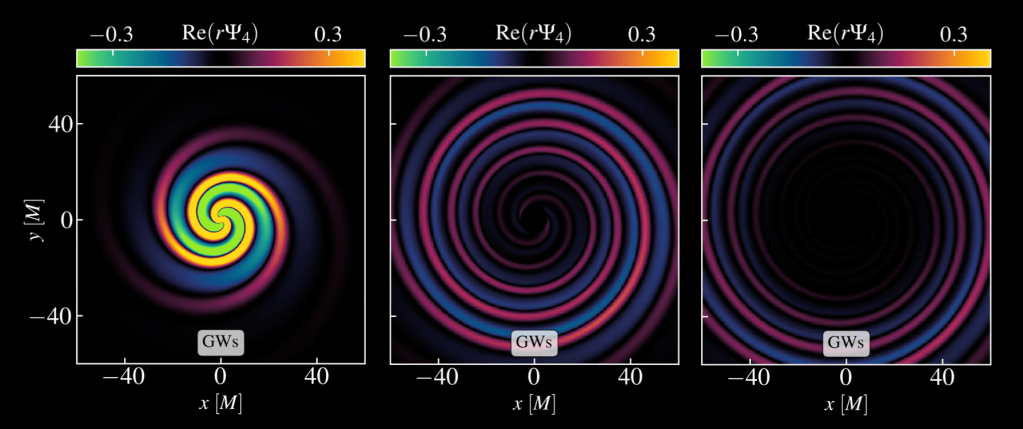
“Strong Spacetime” studies how black holes behave when gravity’s nonlinearity is essential, with an emphasis on stability and observable dynamics. Building on recent linear and fully non‑linear advances, we aim to extend rigorous stability results from non‑rotating (and very slowly rotating) cases to all sub‑extremal Kerr black holes—i.e., rotating holes with spin below the maximal (“extremal”) limit. These results characterize the gravitational radiation emitted by a perturbed black hole (including non‑linear memory), the way its event horizon evolves and settles, and how its final mass and spin change. In parallel, we will probe whether extremal black holes can form in realistic collapse by treating near‑extremal formation as a critical phenomenon: assessing near‑horizon linear instabilities, following their non‑linear development with analysis and numerical relativity, and identifying gravitational‑wave signatures that would uniquely signal this pathway.
To connect rigorous theory with data, we focus on the ringdown—the relaxation of a perturbed black hole to its stationary state, which, at late times can be described by quasinormal modes (the exponentially-damped sinusoidal tones of a perturbed black hole). We will clarify when this quasi-normal description is reliable by dissecting the spectral instability of the pseudospectrum, quantifying how tiny perturbations—arising from non‑linear general relativity, ordinary or dark matter, or beyond‑Einstein effects—can shift or destabilize modes, and modeling their observability. We will make precise the link between eikonal quasinormal modes and the photon ring/shell (the unstable orbit of light) by computing ringdown amplitudes for inspirals into Kerr and constructing an “eikonal ringdown waveform,” enabling detailed comparisons with extreme‑mass‑ratio signals. Beyond linear theory, we will study the excitation of non‑linear quasinormal modes and unexpectedly large early‑time tails, build waveform models that include these effects, and test them against observations.
THE STRONG SIGNATURES WORKING GROUP
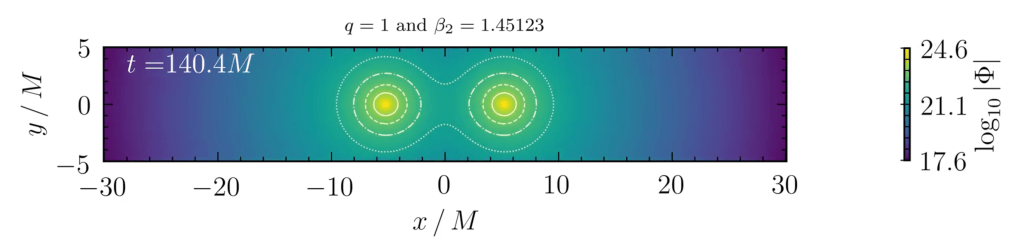
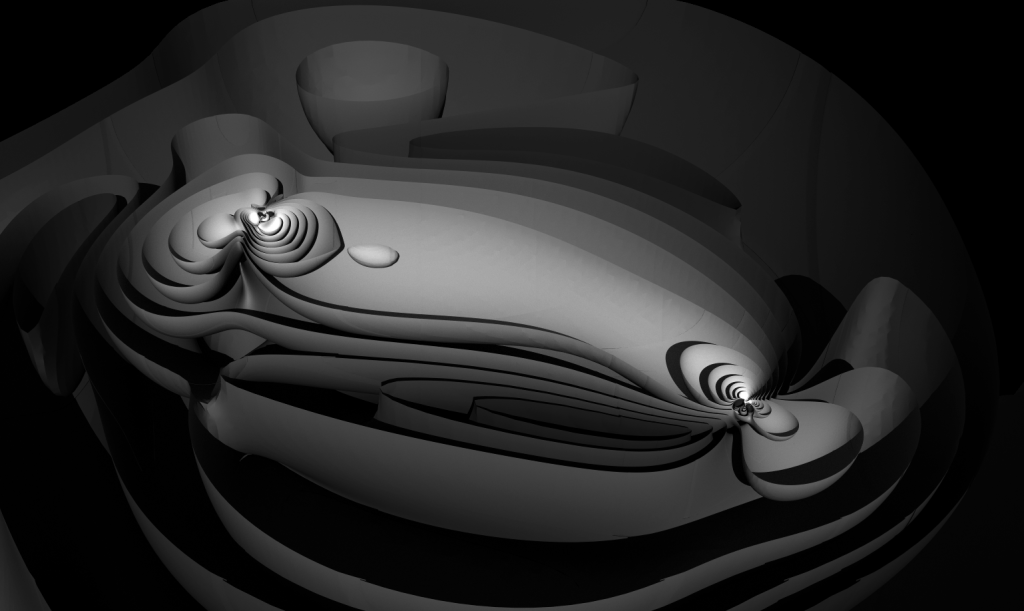
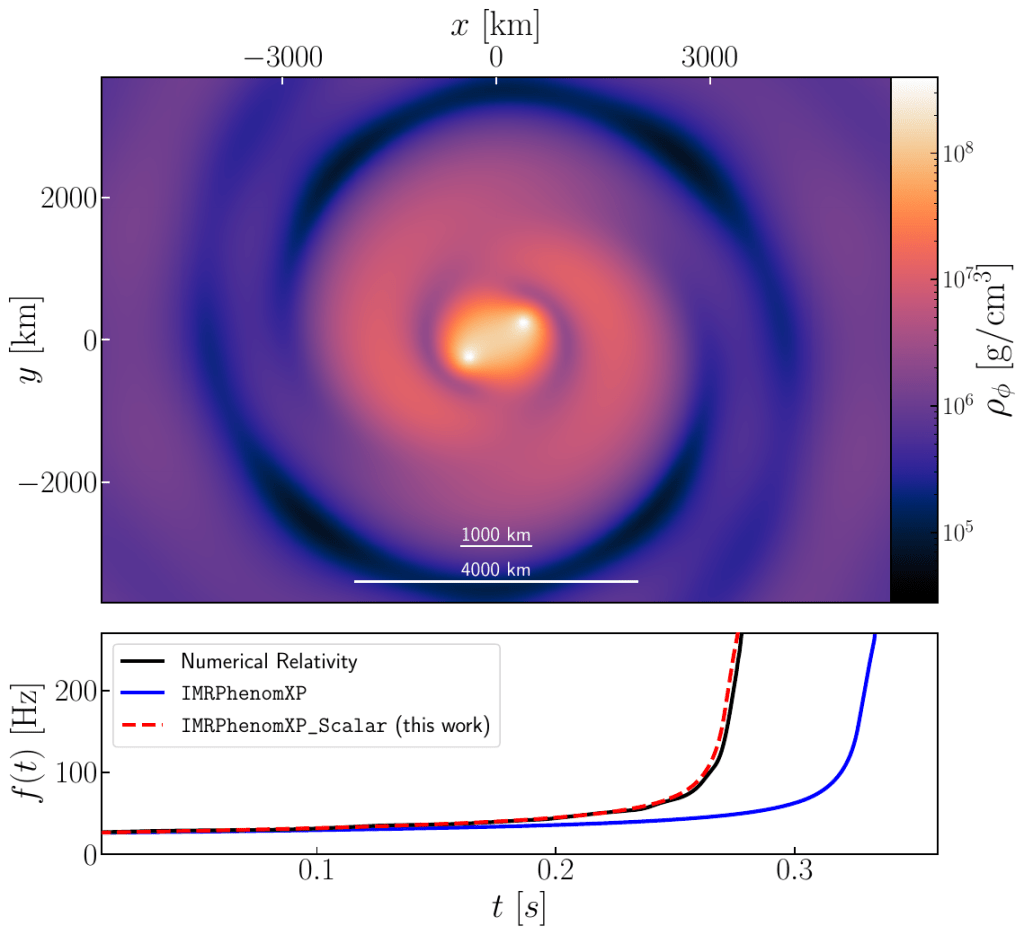
“Strong Signatures” explores the rich phenomenology of gravity in its most extreme regimes, with the goal of uncovering observable signatures of strong gravitational dynamics beyond those expected in Einstein’s GR and standard astrophysical scenarios. We will to combine theoretical insights, mathematical relativity and advanced numerical modelling to identify signatures of new physics in nonlinear gravity regimes.
A major focus will be the nonlinear dynamics of black hole mergers, where gravity becomes dynamical and spacetime is highly curved. We are developing and applying new numerical methods capable of evolving higher-derivative effective field theories in order to characterize waveform signatures of new physics. These simulations will also serve as diagnostics of theoretical consistency, revealing when putative beyond-GR corrections trigger instabilities or drive the dynamics outside the regime of validity of an effective description. To ensure robust interpretation of future observations, we will quantify the potential for degeneracies between new signatures and astrophysical effects that can mimic them. Our models will support both targeted tests of specific theories and theory-agnostic searches for anomalies in current and future gravitational-wave data using Bayesian inference and model selection, working in collaboration with the Strong Observations group.
More broadly, the group will investigate whether extreme gravitational regimes expose fundamental limitations of classical GR, effective field theory, or standard assumptions underlying black-hole physics and singularity formation. Leveraging recent advances in mathematical relativity, high-performance computing, and numerical methods, we will study gravitational collapse and horizon dynamics in both Einstein gravity and beyond-Einstein scenarios, exploring whether strong-field effects can regulate singularities, amplify tiny corrections near horizons, or generate qualitatively new observable phenomena. Through this broader perspective, Strong Signatures aims not only to test gravity, but to deepen our understanding of spacetime dynamics itself and identify the most promising arenas where future observations may reveal genuinely new gravitational physics.
THE STRONG OBSERVATIONS WORKING GROUP
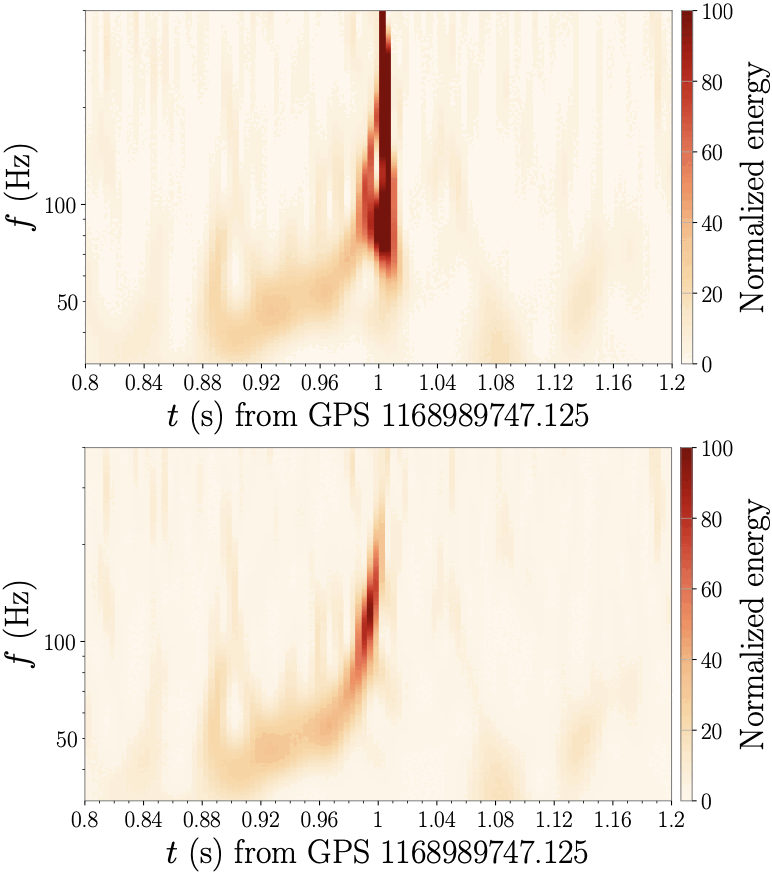
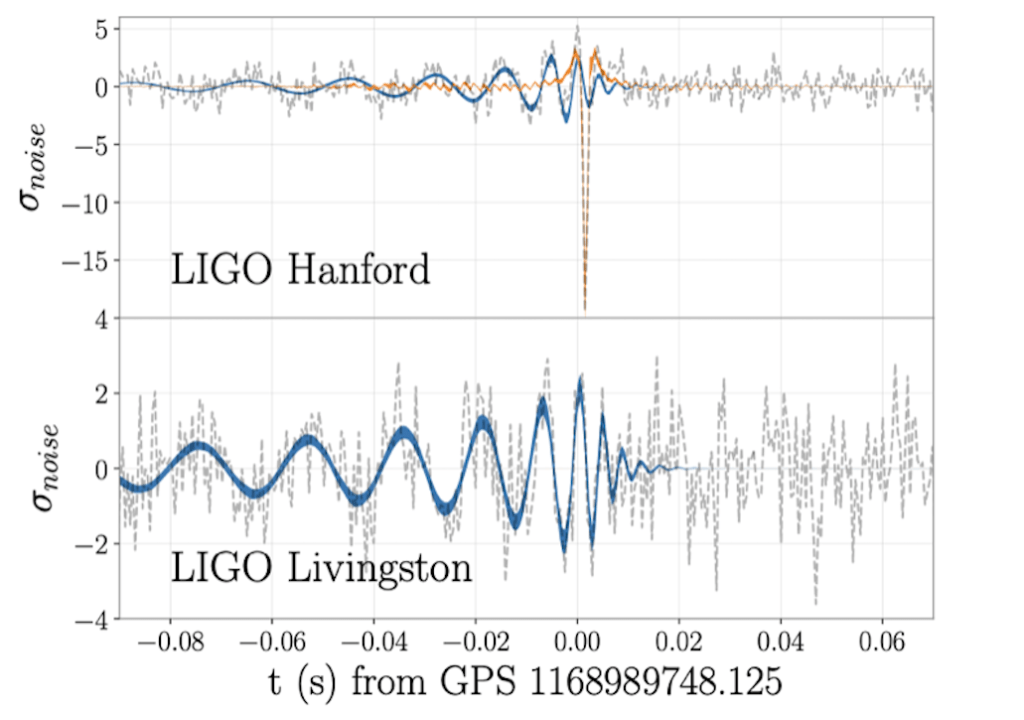
The “Strong Observations” working group will turn gravitational‑wave observations into robust tests of strong gravity while guarding against false positives from the instruments. We will quantify how data gaps, time‑varying and non‑Gaussian noise, and calibration errors could bias searches for beyond‑Einstein signatures in the late inspiral and in the non‑linear ringdown. Because binaries of different total masses and redshifts probe different frequencies, they sample detector noise differently; we will exploit this, and the expectation that true beyond‑GR effects should recur across black‑hole mergers and across detectors, to separate astrophysical anomalies from detector artifacts and to develop mitigation strategies. In parallel, we will pursue agnostic, effective‑field‑theory–motivated tests by extending the parameterized‑post‑Einsteinian (ppE) framework, which organizes deviations by the order at which they first modify the waveform and by how they scale with the system’s total mass. If the data favor a deviation with a specific power‑law exponent, we can rule out broad classes of theories and strengthen discrimination against systematics. These tests will be deployed on single events and—through hierarchical population analyses that account for mass ratio and spin—across the growing event catalog, mapping which classes of anomalies are easiest to detect in current and future detectors.
To remain sensitive to surprises, we will also conduct unmodeled searches for novel strong‑gravity phenomena. We will combine trans‑dimensional Bayesian inference—reversible‑jump Markov chain Monte Carlo that flexibly adjusts model complexity—with modern machine‑learning tools that learn fast, flexible posterior approximations from simulations (normalizing‑flow networks). This machine‑learning‑enhanced framework will let us traverse both model and parameter spaces, distinguish new physics from unmodeled instrumental behavior, and search for non‑linearities in mergers and ringdown. We will apply it to current data to obtain the tightest constraints—or first detections, if present—of physics beyond general relativity. Finally, by injecting numerically simulated beyond‑Einstein waveforms and recovering them with our unmodeled pipeline, we will build a “dictionary” that maps any recovered anomalies to concrete physical effects, allowing us to translate detections or upper limits into statements about underlying symmetries and operators in candidate theories.